



Hybrid Working didn’t create weak leadership, it exposed it
Last week, I commuted into London twice for work and by the end of the week I was exhausted! This week as I look at my diary and see two in person meetings, I find myself groaning at the additional time and effort this will require.
And yet, I also know, without doubt, that some of my best conversations, deepest connections and strongest ideas happen when I’m physically with other people.
I find myself wondering which of these two voices in my head I should listen to?
In the post COVID world, Hybrid working continues to be a widely debated, complex challenge for most organisations – including our own here at Full Potential Group. More than a quarter (28%) of working adults in Great Britain now work in a hybrid pattern.
Most of the debate centres around where people are working; office mandates and attendance policies, but having read around the topic and listening to our clients, we think the more important question is how people are being led.
One truth seems to be consistently standing out
Hybrid working hasn’t created weak leadership, it has exposed it.
For years many of us have relied on proximity to compensate for poor leadership (ouch, perhaps a little harsh but perhaps true!). People bumped into each other, managers overheard conversations, problems surfaced by accident, relationships were repaired over coffee or corridor conversations.
Hybrid strips much of that away & remote leaves us standing naked!
Suddenly leadership has had to become far more intentional & this is hard!
The burning question we are asking of ourselves and inviting you to ponder over is…
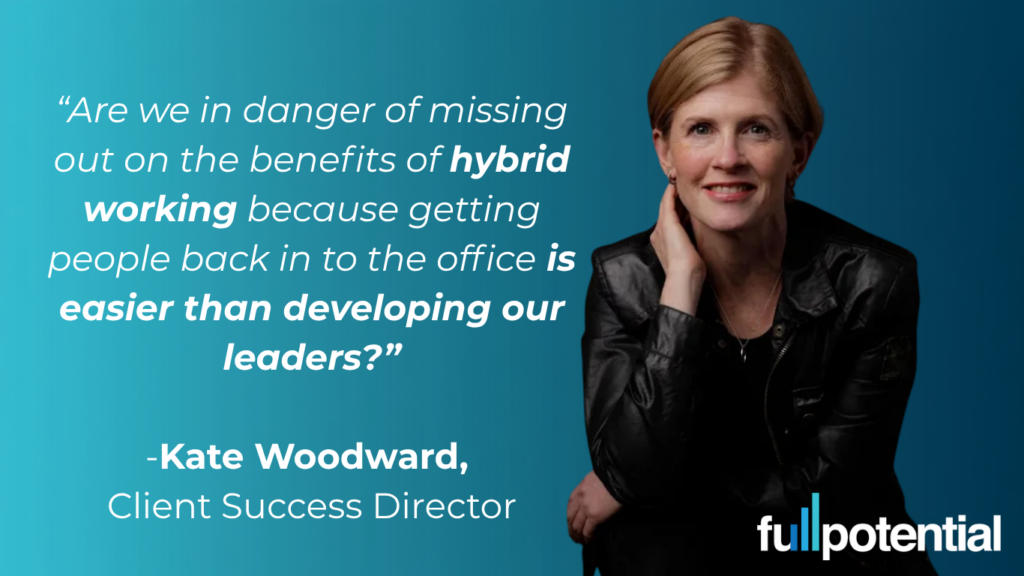
Are we in danger of missing out on the benefits of hybrid working because getting people back in to the office feels easier than developing our leaders?
We don’t pretend there is a silver bullet but it’s a debate we want to open up in this article, and the one we’ll go much deeper on in our webinar next week (see below for more details)
So, what’s happening in organisations?
There’s some fascinating activity going on out there;
- Some organisations, notably in the banking sector have started linking bonuses to attendance in an effort to strengthen culture, collaboration and accountability. The underlying belief is understandable, trust and cohesion are harder to build without regular face to face time.
- At the same time, many CEO’s are conflicted, on one hand they would like greater office attendance but also recognise that flexibility has become a valued aspect of modern working life. .
- According to the CBRE 80% of UK organisations have a formal RTO policy in place yet only 17% are actively enforcing it & the gap between policy and practice causes confusion, breeds resentment and nibbles away at culture.
There’s also another dimension to this debate that leaders can’t afford to ignore.
One of the risks of simplifying hybrid working to an office attendance issue is that we start optimising for the easiest thing to measure rather than the outcomes that mater most.
Take for example, talent retention. Flexible working is a critical factor for those balancing their careers with caring responsibilities. Women still take the majority of unpaid child and elder care duties, meaning they are often the first to feel the impact of more rigid workplace practices.
If organisations respond to hybrid challenges by only increasing office mandates, they may unintentionally lose talented people they can least afford to lose.
Its tempting to simplify the debate because looking into the dark corners where the real issues exist is much harder work.
Despite organisations having wildly different policies, they are all wrestling with similar questions.
How do we build trust, strengthen communication, encourage genuine collaboration and create accountability without relying on proximity?
Which tells us that maybe policy isn’t the problem.
Even if you’re still questioning whether you’ve got the right return-to-office policy, one thing is becoming increasingly clear: the organisations getting the best from hybrid working aren’t succeeding because of their policy. They’re succeeding because of their leadership.
They are succeeding because of their leadership.
Great hybrid leaders seem to have the following disciplines in common
- They focus on setting very clear, explicit team and individual expectations & recognise the need for more frequent communication touch points.
- They build trust through intentional consistency rather than accidental visibility.
- They ensure that in-person time genuinely matters & is purposeful.
- They notice when connection weakens, before it shows up in individual or team performance.
Perhaps we’ve spent too long asking how many days would people spend in the office when the better question might be
Are we truly developing leaders who have the capability and the capacity to build trust, collaborate and communicate effectively from a distance and ensure accountability without proximity?
Because hybrid working isn’t going away,
The organisations that thrive won’t necessarily be those with the strictest attendance policies or the smartest technology.
They’ll be the ones with leaders who know how to build trust, create clarity and sustain performance wherever their people are working.
If this article has resonated with you, we’d love you to join us for our upcoming webinar. Leading Hybrid Teams: How to build trust, Accountability and Performance.
Together we’ll be exploring
- The behaviours that quietly build or erode trust in hybrid teams
- Why leadership capacity is becoming the differentiating factor
Practical actions you can put into practice immediately
Related Articles