



The 5 Leadership Capacities That Define Leaders Who Succeed
If you are not talking about leadership capacity in your organisation, you need to be.
Our research shows that leaders are operating at, on average 53% of their capacity; cognitively, emotionally, relationally, operationally, regeneratively.
It’s not surprising
The leadership frameworks and training most organisations are still following were built for a different era, leaders had time to learn their trade, to develop their abilities. But in a BANI world ; brittle, anxious, non-linear, incomprehensible, leaders no longer have this luxury.
“So many of the businesses we speak to have a capacity issue, not a capability one” – Carol Gaskell, Founder and CEO Full Potential Group

What does BANI actually mean for leaders?
VUCA gave us a vocabulary for complexity but BANI goes further – it describes a world that doesn’t just move fast, but one that can feel broken, unstable, illogical and very difficult to predict
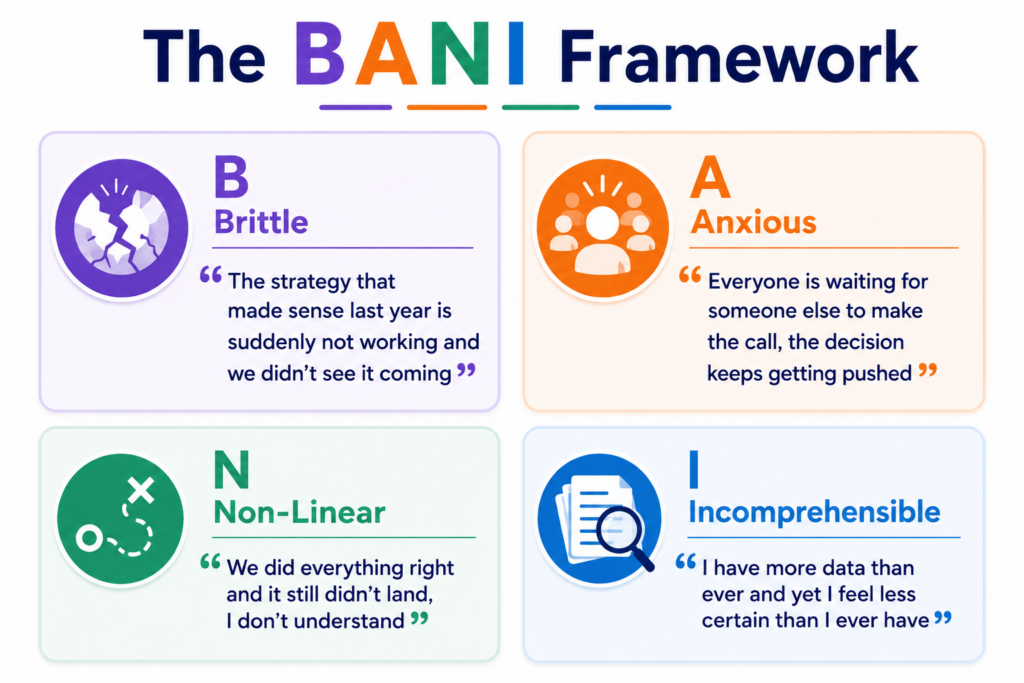
Great leaders in a BANI world don’t need more knowledge, they need the capacity to think clearly when the picture is incomplete, stay centred & grounded when the pressure is relentless and align the people around them when change and uncertainty are the only constant, and they need it now!
The Real Issue
Capability v’s capacity – why this distinction matters
When leaders lack capability, the gap is easy to identify “we don’t know how to use this technology”, the problem is easy to articulate & the solution is obvious.
When leaders lack capacity, the gap is much harder to identify & diagnose; the brain panics, the emotions heighten, focus narrows, decisions stall. accountability is avoided, culture unravels. Senior talent masks the struggle but quietly disengages, it’s just too much.
The Shift
5 essential leadership capacities that define leaders who will both succeed and sustain
These are not personality traits, these are measurable and trainable, but only under the right conditions. Together they form an operating system of leadership that can hold complexity without breaking under the pressure of it.
Cognitive Capacity: The ability to make better decisions in complexity.
Relational Capacity: The ability to align, influence and create shared direction.
Emotional Capacity: The ability to stay centred and grounded under pressure.
Operational Capacity: The ability to make balanced decisions without compromise
Regenerative Capacity: The ability to lead with purpose & sustain collective energy over the long term
Find out where your leaders capacity really sits. Take our leadership Capacity Assessment or drop us a line and lets have a conversation
Related Articles