empowering leadership, transforming culture
empowering leadership, transforming culture



Collaboration is where performance is either accelerated or slowed. Most organisations don’t struggle with effort. They struggle with how effectively teams work together across boundaries, functions and locations.
When collaboration is strong, work flows. When it isn’t, progress slows, often in ways that are difficult to diagnose but highly impactful.
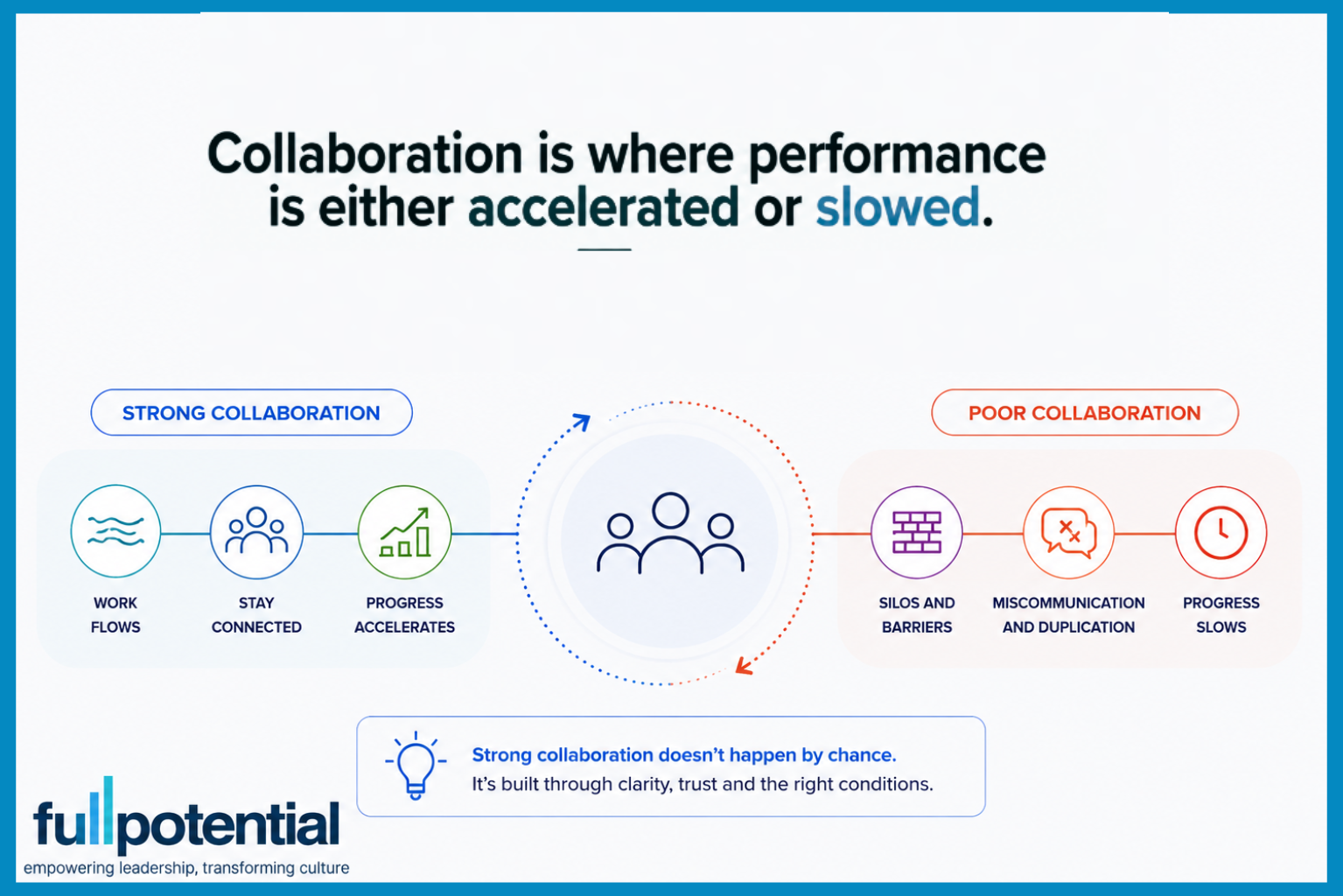
As organisations grow, collaboration becomes more complex. Teams rarely struggle because people aren’t working hard. More often, performance is affected by how effectively people collaborate across functions, departments and locations.
Without effective collaboration, organisations often experience:
These challenges rarely come from a lack of effort. They come from how effectively teams collaborate together.
How people work together shapes collaboration every day.
A collaborative mindset encourages openness, shared ownership and cooperation.
Clear, open communication keeps teams connected and informed.
Trust enables people to share ideas, challenge thinking and work openly together.
Clear priorities, roles and expectations help teams move forward together.
Leaders create the conditions for effective collaboration across teams.
Tools can enable collaboration, but they cannot create it. Without the right behaviours, mindset, communication, trust, clarity and leadership, even the best tools won’t improve how teams work together.
High-performing organisations create collaboration that is:
To improve collaboration, you need to strengthen how your teams:
Many organisations operate as a collection of teams rather than a connected system.
The shift is from:
• Siloed teams → Connected teams
• Local priorities → Shared outcomes
• Independent working → Collaborative execution
This is what enables organisations to operate effectively at scale.
One of the biggest risks with collaboration is over-complication.
Too many meetings.
Too much alignment.
Too little action.
Effective collaboration balances:
• Alignment → with action
• Communication → with clarity
• Input → with decision-making
The goal is not more collaboration. It is better collaboration.
See how stronger collaboration improves execution, efficiency and organisational performance across teams, functions and locations.
When team collaboration improves, you will see:
• Faster cross-team execution
• Reduced duplication and wasted effort
• Stronger communication between teams
• Better alignment across functions
• Improved relationships and trust
• More effective decision-making
• Greater organisational efficiency
• Improved performance and delivery
Performance doesn’t just happen within teams. It happens between teams.
Improving collaboration strengthens:
• Execution
• Efficiency
• Innovation
• Speed
• Organisational effectiveness
When collaboration is strong, your organisation becomes:
• More aligned
• More efficient
• More responsive
• More effective
You create teams that don’t just perform individually, but deliver together.
If collaboration is slowing execution, improving how teams work together will unlock performance
quickly.
If your challenge is more focused on leadership alignment or team performance, explore complementary solutions that strengthen alignment, decision-making and delivery.


We have helped unlock the potential in over 1 million individuals, hundreds of teams and more then 2,500 organisations since 1998. These are some of the clients we have partnered with, many of whom have been working with us for years. We are extremely grateful for the recommendations and repeat business we receive.
Don’t just take our word for it though, read some of our client feedback